6.5 Incorporation of environmental design in buildings

Version 3.1 by Emily West on 2022/01/19 15:07

6.5 Incorporation of environmental design in buildings

Project Name: UNaLab

Pillar of Sustainable DevelopmentSocietal challenge
People6 - Place Regeneration
Description

Degree to which buildings are designed to be environmentally friendly with respect to energy efficiency, water consumption, waste production, indoor environmental quality, and implementation of NBS (unitless value).

Environmental design is a broad concept concerning the structural, design and systemic features of buildings defining their impact on their environment. It is related to the concept of green buildings, which refers to environmentally sustainable design, construction, operation, maintenance and end of life of buildings.

Scale as linked to D2.2 framework
  • City
  • Neighborhood 
  • Street
Data source [ link to data framework]
  • Building 
Data needs
  • Energy efficiency, water consumption, waste production, indoor environmental quality, and implementation of NBS of buildings
Expected Outputs
  • Annual measurements
Calculation methods
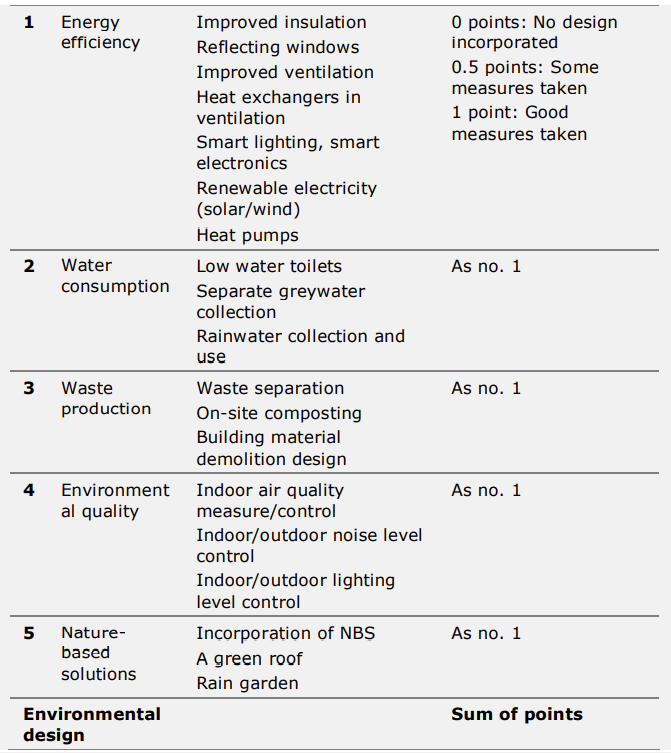
  • The area is divided into buildings, groups of buildings or blocks that represent similar building stock, as seen suitable. Each component is assessed on its environmental design considering incorporated environmental design considering parameters listed in Table 1. The building(s) being assessed are scored from 0 to 1 with respect to each parameter. The average point score (0 to 5) of a building provides the indicator value, i.e., the degree to which buildings are designed to be environmentally friendly with respect to these parameters.
  • Table 1: Parameters for environmental design in buildings (or groups of buildings).
  • 1642604713418-476.png
  • 1642604731837-881.png
Links and references
  • Doan, D. T., Ghaffarianhoseini, A., Naismith, N., Zhang, T., Ghaffarianhoseini, A., & Tookey, J. (2017). A critical comparison of green building rating systems. Building and Environment, 123, 243–260.
  • Sharifi, A., & Murayama, A. (2013). A critical review of seven selected neighborhood sustainability assessment tools. Environmental Impact Assessment Review, 38, 73–87.
  • Sharifi, A., & Murayama, A. (2014). Neighborhood sustainability assessment in action: Cross-evaluation of three assessment systems and their cases from the US, the UK, and Japan. Building and Environment, 72, 243–258

Revisions

VersionNameDateChanges made
0.1Emily (EcoWise)19/01/2022Factsheet created