
8.1 Green intelligence awareness
8.1 Green intelligence awareness
From project URBAN GreenUP
Description | Changes in behavior and human attitudes are fundamental to achieve a more sustainable world, so that, it is very interesting to analyze the potential of an activity or intervention to increase the green intelligence awareness of a population. There is enormous opportunity for nature-based solutions to promote understanding of sustainability in ways that positively influence citizen behavior. There are many available resources to learn and understand the fragility of our environmental and the responsibility of humans to protect, preserve and respect the world. Therefore, this KPI aims to reflect how the intervention is used for educational purposes and enhancement of public awareness. The Green intelligence awareness is opened to all educational and social groups, no matter what is the level of education (Post-graduate, university, school, basic education). |
Scale as linked to D2.2 framework |
|
Data source and input type |
|
Connection with SDGs |
|
Data needs |
|
Expected Outputs |
|
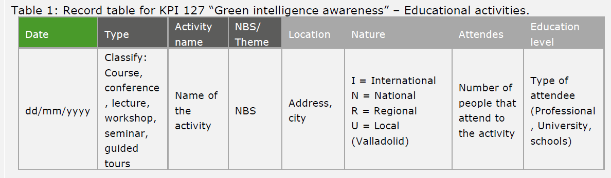
Calculation methods | There are two different categories: Educational activities and Communication activities. 1) Educational activities: The educational activities considered have to be directly or indirectly related with the URBAN GreenUP project. In the “Directly” category there are actions of the themes and NBS of the project. There can be also considered educational actions “Indirectly” related with the URBAN GreenUP project: These are activities organized by other entities and stakeholders different from the URBAN GreenUP Consortium, which are about the URBAN GreenUP general themes, such as climate change, green infrastructure, nature based solutions, sustainability, water management, resources efficiency, etc. The measurement of the KPI “Green intelligence awareness” by educational activities is expressed in the number of activities and number of recipient people (attendees): a) Number of educational activities (nº activities/month). We differentiate among classes: courses, conferences/symposia, lectures, workshops, seminars, guided tours. b) Number or people that attends to the educational activities (nº attendee/activity/class), for instance, number of people that attends to a Climate Change congress. This category could be characterized according to its characteristics: Educative level (University, school), average age, sector (architect, parks and gardens, industry, mobility, biomass). There will be recorded a monthly record. There will be identified the NBS or related theme, such as climate change, Nature Based Solutions and others.
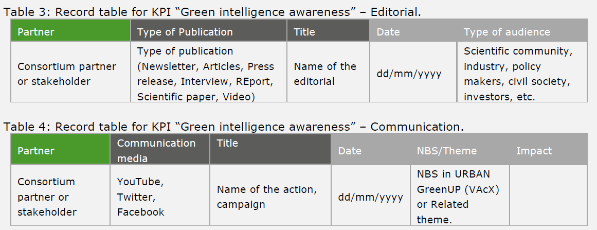
2) Communication activities.
The measurability of KPI is also expressed as the size of the audience that is exposed to the communication activity impact (number of retweets and likes in Twitter, number of likes and shares in Facebook, number of plays in YouTube, etc.) The KPI is calculated monthly. There will be calculated a total KPI annually, with will generate at least three indicators (numbers): Number of activities per year, Number or people that attends to the educational activities and Number of publications per year.
|
Links and references |
|

Revisions
| Version | Name | Date | Changes made |
| 0.1 | Hyunji (EcoWise) | 14/02/2022 | Factsheet created |