PAS 182
Entry No | ECOWISE - 5 |
Strategic area(s) | Data Management |
Name of partner | EcoWise (Emre Yontem) |
Resource / link | British Standards Institute (BSI) - Publicly Available Specification (PAS) 182 Smart city concept model
|
Location, Description of intervention/project | Standard & guidance on location agnostic data model |
Geographical scale of the project | Urban Scale |
Background information |
A PAS (Publicly Available Specification) is a fast-track standardization document – the result of an expert consulting service from BSI. It defines good practice for a product, service or process. It's a powerful way to establish the integrity of an innovation or approach. The PAS 182 has been developed around concepts from the public sector concept model (PSCM), aimed at providing the basis of interoperability at the upper ontology level and outlines details of the smart city concept model (SCCM).
|
Objectives defined | The standard establishes an interoperability framework for smart cities in which:
The smart city concept model (SCCM) provides a framework that can normalize and classify information from many sources so that data sets can be discovered and combined to gain a better picture of the needs and behaviours of a city’s citizens (residents and businesses).
|
Metrics used | The PAS does not specify metric, but how they can be defined and related to other smart city concepts.
|
Diversity dimension and findings |
The model can allow identify the relation between diverse groups of people defined as communities, agents with certain relations to events and related objectives. The model can allow identify the clusters of people based on certain criteria and how they can be linked to the urban decisions and services.
|
Result summary |
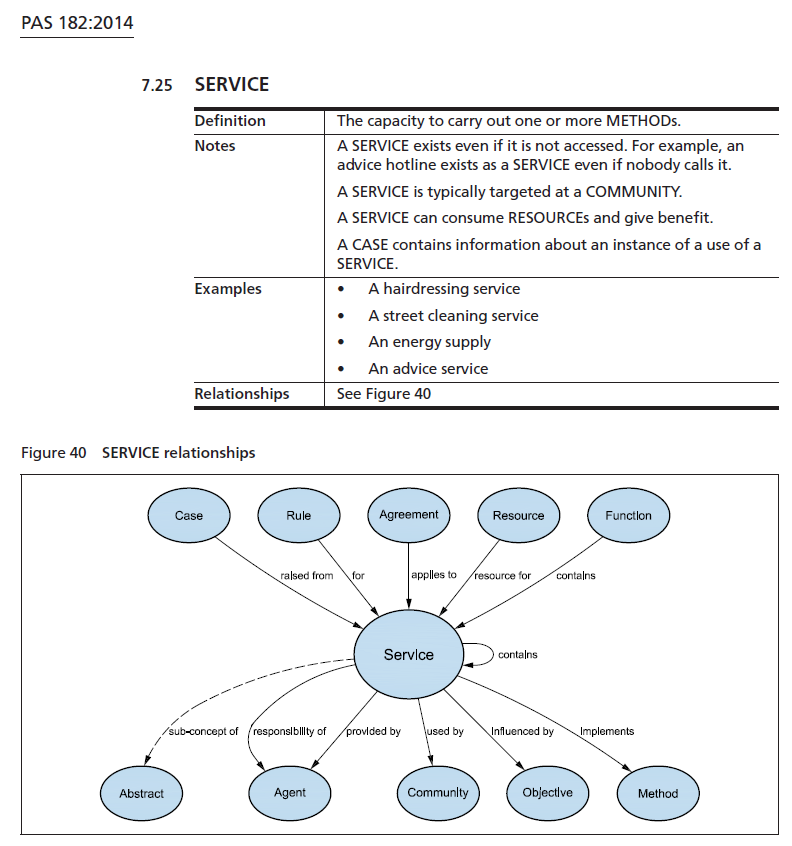
The model is a framework guideline that allows various concepts / entities in the urban ecosystem be managed as system components. The below example can be seen relevant to an urban service, which might be park or transportation related service, with certain benefits to a community. AS you will see below, various concepts (entities) are used to categorise the stakeholders, and the relations are identified. This model allows the links and relations be utilised, even if there is no concrete structured data flow among them at all times. The expected impacts or benefits can be addressed, as well as qualitative findings being referenced to the related entities. For example, in the case of a survey being carried out on the beenfits of a service, we can link the outcomes of the survey to objectives and also to agents/communities. Even if the outcome is a link of a set of answers to an entity, the model can allow the access, and further structured analysis of the findings.
Example of how an Agent (including people) is modelled:
|
Input for DivAirCity and action items |
|
Notes | Further reading: Ontological Representation of Smart City Data: From Devices to Cities Paola Espinoza-Arias , María Poveda-Villalón , Raúl García-Castro and Oscar Corcho Other related standards: The following standards and publications help address various issues for a city to become a smart city: •The development of a standard on Smart city terminology (PAS 180) •The development of a Smart city framework standard (PAS 181) •The development of a Data concept model for smart cities (PAS 182) •The development of a Guide to establishing a framework for sharing data (PAS 183) •The development on Project proposals for delivering smart city (PAS 184) •The specification for establishing and implementing a security-minded approach (PAS 185) •The development of Smart cities -Supplying data products and services for smart communities (PAS 186) •A Smart city overview document (PD 8100) •A Smart city planning guidelines document (PD 8101) •The development of a standard on smart city concept model (BS ISO/IEC 30182:2017) •The development of a standard on inventory of existing guidelines and approaches on sustainable development and resilience in cities (PD ISO/TR 37121:2017) •A guide to city resilience (BS 67000:2019) Other smart and sustainable cities and communities standards •An indicator reporting standard for quality of life and services in cities (BS ISO 37120:2014) •Research on smart infrastructure projects (PD ISO/TR 37150:2014) •A specification for KPIs for smart infrastructure projects (PD ISO/TS 37151:2015) •The development of a standard on sustainable development in communities (BS ISO 37101:2016) •The development of a standard on sustainable cities and communities (BS ISO 37100:2016) •The development of a standard on Smart community infrastructures -- Common framework for development and operation (PD ISO/TR 37152:2016)
|