Description | Total carbon removed or stored. Accounting for C stored in soil and vegetation in an urban area can indicate the condition of natural green spaces, total free surface area and total quantity of vegetation in the area examined. Measures of C storage and sequestration also provide a tangible connection to climate change mitigation, and the impacts of local land use, planning and management decision-making. It is important to note the substantial variation in C sequestration and storage capacity of different types of NBS |
Scale as linked to D2.2 framework | - National
- City
- Neighborhood
- Street
- Household
- Object
|
Data source [ link to data framework] | - CORINE landcover information or similar local dataset
|
Data needs | - Requires C storage to be determined from either Carbon storage and sequestration in soil or Carbon storage and sequestration in vegetation indicators
- net forest growth rate for the most common type group in region
- mean canopy cover percentage for all forested pixels in the region
- mean canopy cover percentage for all non-forest pixels in region
- area sum of all non-forest pixels in region
|
Expected Outputs | - Measured as per unit area per unit time
- tonnes/ha/y or similar unit
- Annual data collection
|
Calculation methods | To evaluate C removal or storage per unit area per unit time: - Determine C storage in vegetation or soil as described in Carbon storage and sequestration in vegetation or Carbon storage and sequestration in soil indicators, respectively, for the same area at two different points in time
- Divide each C storage value obtained by the area assessed to determine C storage per unit area
- Subtract the earlier value obtained for C storage and sequestration/unit area from the more recent value, then divide by the length of time between measures to obtain an estimate of C removal or storage per unit area per unit time.
The growth rate of a forest has significant impact on its C storage potential. Forest C sequestration (FCS) is usually estimated as a function of forest area, forest type, and forest age: 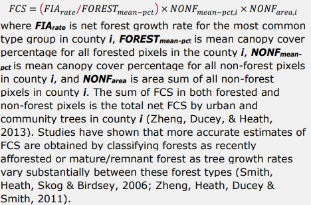
|
Links and references | - Smith, J.E., Heath, L.S., Skog, K.E., & Birdsey, R.A. (2006). Methods for Calculating Forest Ecosystem and Harvested Carbon with Standard Estimates for Forest Types of the United States. USDA Forest Service Report GTR-NE-343. Newtown Square, PA: Northeastern Research Station, United States Department of Agriculture, Forest Service.
- Zheng, D., Ducey, M.J. & Heath, L.S. (2013). Assessing net carbon sequestration on urban and community forests of northern New England, USA. Urban Forestry & Urban Greening, 12, 61- 68.
- Zheng, D., Heath, L.S., Ducey, M.J. & Smith, J.E. (2011). Carbon changes in conterminous US forests associated with growth and major disturbances: 1992–2001. Environmental Research Letters, 6, 014012.
|

