2.3.4 Avoided emission through building energy efficiency improvement and renewable integration
2.3.4 Avoided emission through building energy efficiency improvement and renewable integration
Social challenge/ impact linked to: | Environmental |
Co-creation phase linked to: | E) Co-monitoring |
Level of importance | 1 - High Importance / must have |
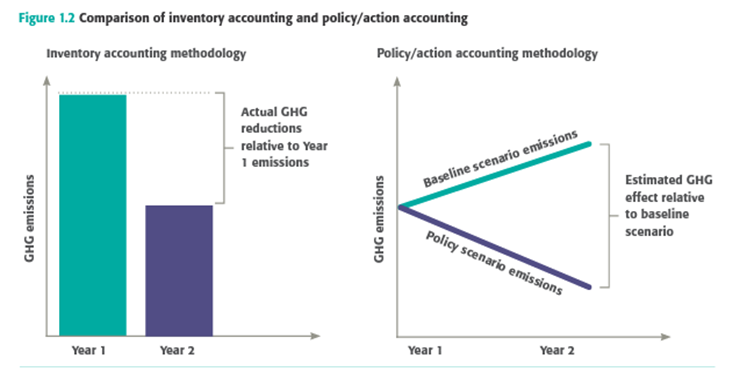
Description | Climate change causes a number of environmental mechanisms that affect both the endpoint human health and ecosystem health. Climate change models are in general developed to assess the future environmental impact of different policy scenarios. Greenhouse gases emission indicators encompass a variety of measurements on the emission and concentration of Greenhouse gases. Greenhouse gases are those gaseous constituents of the atmosphere, both natural and anthropogenic, that absorb and emit radiation at specific wavelengths within the spectrum of thermal infrared radiation emitted by the Earth‘s surface, the atmosphere itself, and by clouds. This property causes the greenhouse effect. This indicator measures the emissions of the six main GHGs which have a direct impact on climate change. This indicator aim to quantify the amount of greenhouse gases (GHG) avoided as a result of implementation of NBS at the building scale. GHG emissions through NBS can be avoided through reduced consumption of heating and cooling energy demands at building scale for instance.
|
Scale as linked to D2.2 framework |
|
Data source [ link to data framework] |
|
Data Needs |
|
Expected Outputs |
|
Calculation methods |
|
Links and references |
|